Legal practice is increasingly global. Clients span continents. Teams work across time zones and languages. Therefore, the language in which your practice management software operates is no longer a minor detail — it is a strategic necessity.
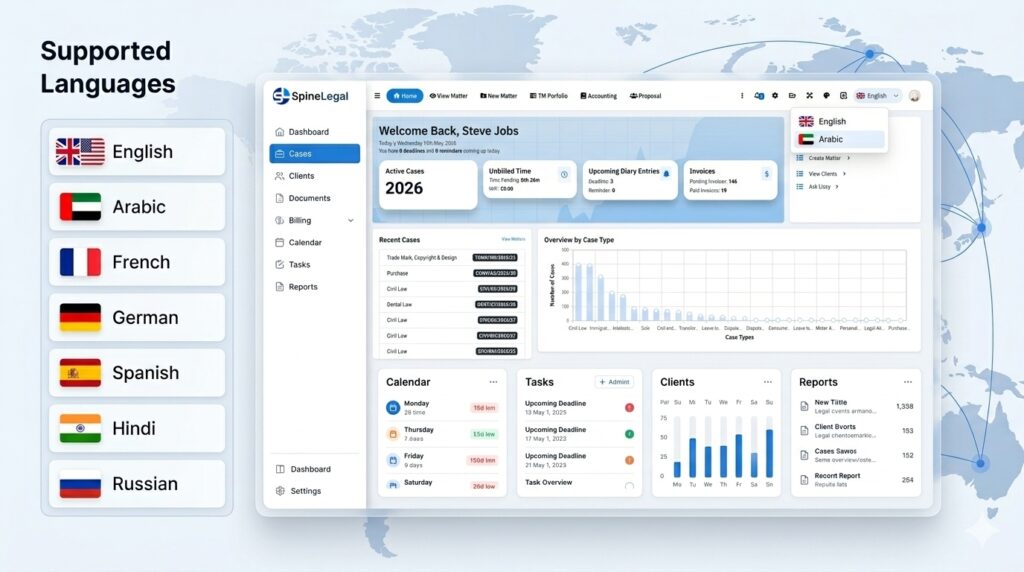
Multilingual legal practice management software has become an essential tool for modern law firms that serve diverse client bases. SpineLegal addresses this need directly. The platform supports English, Arabic, French, German, Spanish, and Hindi — making it one of the most linguistically inclusive legal software solutions available today.
For firms working with Arabic-speaking clients, Arabic support carries particular significance. Arabic presents unique technical challenges. It reads right-to-left (RTL). Its script connects characters in ways that differ fundamentally from Latin-script languages. Moreover, legal terminology requires precision that generic translation cannot deliver. Poor language implementation is not just inconvenient — in a legal context, it is potentially harmful.
This article explores what genuine multilingual support looks like in a legal practice management system, why Arabic support matters, and how SpineLegal delivers on both fronts.
Language barriers create real operational risks. Misunderstood client instructions lead to procedural errors. Incorrectly formatted legal documents create liability. Furthermore, client trust erodes quickly when communication is unclear or imprecise.
Many firms have historically relied on manual translation. However, this approach is slow, costly, and difficult to scale. It introduces additional steps into workflows that are already complex. As client bases diversify, law firms need a system that manages multiple languages at the infrastructure level instead of adding translation support after drafting documents.
Staff diversity is also growing across the legal sector. Teams include paralegals, case handlers, and administrators from varied linguistic backgrounds. A practice management system that works in only one language limits who can use it effectively. It creates internal inefficiencies that affect speed, accuracy, and staff retention.
Therefore, multilingual capability in legal software is not just about client service. It is equally about operational excellence and internal productivity.
Not all software labelled “multilingual” delivers real functionality. Some platforms offer surface-level translations — menus and button labels rendered in another language, while documents, reports, and deeper interface elements revert to the default. This is not multilingual support. It is window dressing.
Genuine multilingual legal practice management software operates very differently. It means:
SpineLegal’s features are built on this comprehensive model. Each supported language is fully integrated into the platform — not bolted on as a cosmetic layer.
Of all the languages SpineLegal supports, Arabic warrants particular attention. It is technically demanding to implement correctly, and most legal software providers have not done so.
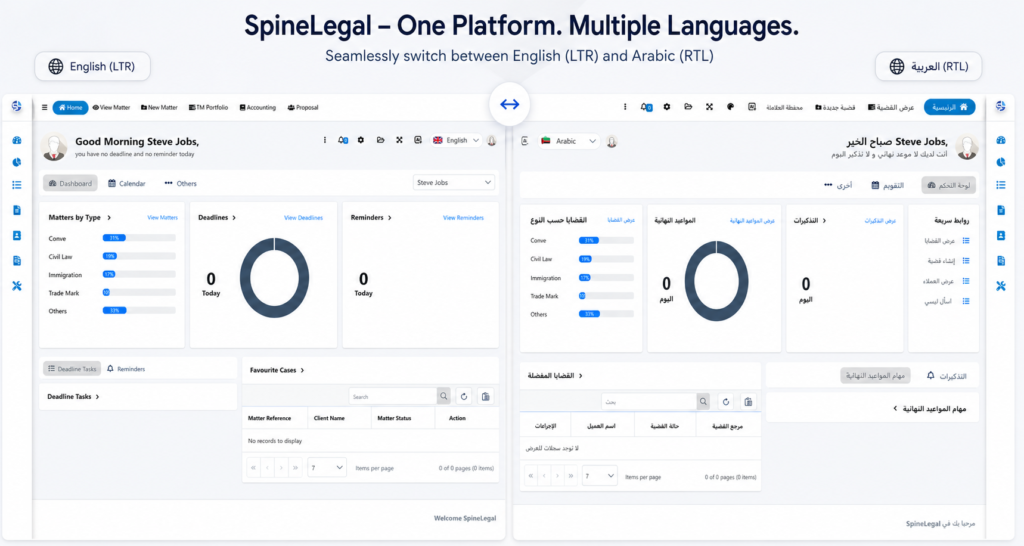
Arabic is written right-to-left. This means the entire interface must mirror. Menus appear on the right. Text aligns differently. Navigation flows in the reverse direction compared to left-to-right languages. Without proper RTL implementation, Arabic text becomes garbled, misaligned, or simply unreadable within standard software environments.
Furthermore, Arabic legal terminology is highly specialised. Terms used in contract law, family law, and commercial litigation carry specific meanings that have evolved within distinct legal traditions. Direct translations from English frequently lose essential nuance. Therefore, SpineLegal’s Arabic implementation is built with legal context in mind — not merely linguistic conversion.
For any firm serving Arabic-speaking clients, this level of precision matters. It ensures that case notes, client correspondence, billing descriptions, and generated reports communicate accurately and professionally — in the way a client expects to be addressed.
According to the International Bar Association, linguistic competence is increasingly recognised as a component of effective legal representation in cross-border matters. This is not merely a professional courtesy — in many jurisdictions, it is becoming a professional standard.
SpineLegal currently supports six languages across its platform:
Each language is fully implemented across all core modules. These include case management, time recording, billing, client records, and document generation. Consequently, no platform function is restricted or degraded based on language choice.
Firms can also operate in a mixed-language environment. For example, one fee earner can work in Arabic whilst a colleague operates in French — both within the same firm account and on the same matter. This flexibility makes SpineLegal particularly well-suited to international law firms, immigration practices, and any firm with a genuinely multilingual team or client base.
Multilingual support does not function effectively in isolation. It must be paired with robust, professionally designed legal practice management functionality. SpineLegal combines language inclusivity with a comprehensive suite of operational tools.
Every case can be recorded, tracked, and progressed in the user’s preferred language. Case notes, task assignments, and matter timelines all render correctly in the chosen language. Additionally, matter history remains consistent regardless of language switches — ensuring continuity across all fee earners.
Legal documents can be generated in any supported language directly from within the platform. Templates are available across all supported languages. Consequently, firms can produce client-facing documents — including letters, reports, and invoices — in the client’s preferred language, without manual reformatting or third-party tools.
Time entries and billing records reflect the language of the individual fee earner. Invoices, however, can be rendered in the client’s language independently. This separation of internal and external language settings is operationally significant. It allows firms to maintain internal consistency whilst delivering professional, localised documents to clients.
Clients access their matter information through a localised client portal. For Arabic-speaking clients, the portal renders in full RTL format with appropriate typography. This improves client engagement and reduces the volume of intermediary communication required from fee earners.
Firm-wide reports are generated in the administrator’s chosen language. Data visualisation adapts accordingly. Therefore, senior partners and managers can analyse performance metrics, matter progress, and billing data in whichever language they prefer — without any loss of accuracy or detail.
For a comprehensive overview of all available tools, visit SpineLegal’s practice management platform.
The practical advantages of adopting a multilingual legal practice management platform extend across several operational dimensions.
Client satisfaction improves measurably. Clients who receive documents, updates, and invoices in their native language report higher satisfaction and greater trust in their legal representatives. Additionally, misunderstandings decrease significantly when language is not a barrier at any stage of the matter.
Staff efficiency and confidence increase. When fee earners and support staff can work in their preferred language, they work with greater speed and accuracy. Moreover, onboarding new staff with non-English language backgrounds becomes considerably easier.
Professional risk exposure decreases. Language errors in legal documents carry professional and legal consequences that firms cannot afford. Therefore, a system that supports precise multilingual output at every stage of a matter reduces risk across the board.
Competitive positioning strengthens. Firms that serve clients across linguistic communities attract a broader client base and differentiate themselves from competitors. This is particularly relevant for immigration practices, international commercial law firms, and family law practices serving diaspora communities.
Furthermore, as firms increasingly compete on client experience, language capability is a differentiator that takes significant time and investment to replicate.
Managing legal documents across multiple languages introduces compliance considerations that firms must address carefully. Version control must be maintained rigorously. The correct language version of a document must be identifiable at any point. Moreover, audit trails must remain intact regardless of language settings or user changes.
SpineLegal addresses these concerns through its document management infrastructure. All document versions — regardless of the language in which they were produced — are stored with full version history. Timestamps, authorship records, and matter associations remain consistent and searchable across all language settings.
According to guidance from the Law Society, firms are required to maintain proper records of all client communications and matter documentation. SpineLegal’s approach to multilingual document management supports this obligation directly, without requiring additional manual record-keeping from fee earners.
Transitioning to a new practice management system requires careful planning. However, SpineLegal is designed to minimise disruption during the onboarding process. Language preferences are configured at both firm and individual user level during initial setup. Consequently, each team member can begin working in their preferred language from the first day of use.
Data migration support is available throughout the onboarding process. Existing matter files, client records, and billing histories can be imported into the platform. The structured onboarding process keeps firms fully operational throughout the transition period.
Additionally, training materials and support documentation are available in multiple languages. This ensures that staff across all linguistic backgrounds receive consistent, accessible instruction — reducing the learning curve for every member of the team.
For those considering the platform, SpineLegal’s contact and onboarding page provides direct access to the implementation team, who can guide firms through the process from initial enquiry to full deployment.
Many practice management platforms exist. However, very few deliver genuine multilingual capability at the depth SpineLegal provides.
The distinction lies in the approach. SpineLegal does not translate menus and label it multilingual. Instead, the platform rebuilds its operational logic around each supported language. RTL rendering, localised formatting conventions, language-specific document templates, and mixed-language firm environments are all supported natively — from within the core platform architecture.
For Arabic-speaking firms, and for firms serving Arabic-speaking clients, this is a meaningful and practical difference. It enables professional-grade legal operations conducted entirely in Arabic — not a compromised workaround built on top of an English-language system.
Furthermore, SpineLegal continues to develop and expand its language capabilities. The platform is designed for the global legal market, and its development roadmap reflects that commitment to genuine international accessibility.
If your firm serves clients across linguistic communities — or if your team works across language barriers daily — SpineLegal offers a direct, professionally designed solution.
Book a personalised demonstration and see exactly how SpineLegal’s multilingual capabilities can transform your firm’s operations. Whether your priority is full Arabic RTL support, French-language billing, or a completely bilingual firm environment, SpineLegal is built to meet that need.
Book a Meeting with the SpineLegal Team →
Explore SpineLegal’s Full Feature Set →
Does SpineLegal provide full Arabic right-to-left (RTL) functionality across the entire platform?
Yes. SpineLegal provides complete RTL support for Arabic throughout the platform. The entire interface — including navigation, menus, forms, document output, and the client portal — renders correctly in right-to-left format. This ensures a professional, accurate experience for Arabic-speaking users and their clients at every point of interaction.
Can different team members use different languages within the same firm account?
Yes. SpineLegal allows language preferences to be configured at the individual user level. Therefore, a fee earner working in Arabic and a colleague working in English or French can both operate effectively within the same firm account, on the same matters, without conflict or data inconsistency.
Is SpineLegal suitable for small law firms as well as larger practices?
SpineLegal scales efficiently with the operational needs of growing law firms. Smaller firms benefit from its straightforward interface and rapid onboarding process. Larger practices benefit from its multi-user, multilingual architecture and advanced reporting capabilities. The platform supports both without requiring separate configurations or additional modules.
How does SpineLegal maintain document accuracy across multiple languages?
SpineLegal uses legally contextualised language implementations rather than generic machine translation. Each supported language in SpineLegal includes dedicated document templates. The platform maintains full version control and detailed audit trails for every document, enabling firms to manage compliance confidently across multiple languages.
SpineLegal — Practice management software built for the global legal profession. Visit SpineLegal →