Late payments are one of the most persistent operational challenges facing solicitors and small law firms in England and Wales. Many firms invest considerable effort in delivering high-quality legal work, only to send a legal billing invoice that sits unpaid for weeks — or requires multiple awkward follow-up calls before it is settled.
The frustrating reality is that unpaid invoices are rarely the result of clients being unwilling to pay. Far more often, they stem from invoices that are unclear, poorly timed, or fail to connect the fee charged to the value the client received.
This guide breaks down the practical steps you can take right now to write legal bills that get paid promptly — without the need to chase.
Before improving your billing process, it helps to understand why invoices go unpaid in the first place. According to the Solicitors Regulation Authority’s guidance on client care, fee transparency is a core professional obligation — yet many firms still issue invoices that leave clients confused about what they are actually paying for.
Common reasons clients delay or dispute legal invoices include:
Addressing these issues is not simply about better administration — it is about building client trust through transparency. The Law Society’s practice notes on billing emphasise that clients have a right to understand the basis on which fees are charged. Clear invoices are both a legal best practice and a powerful cash flow tool.
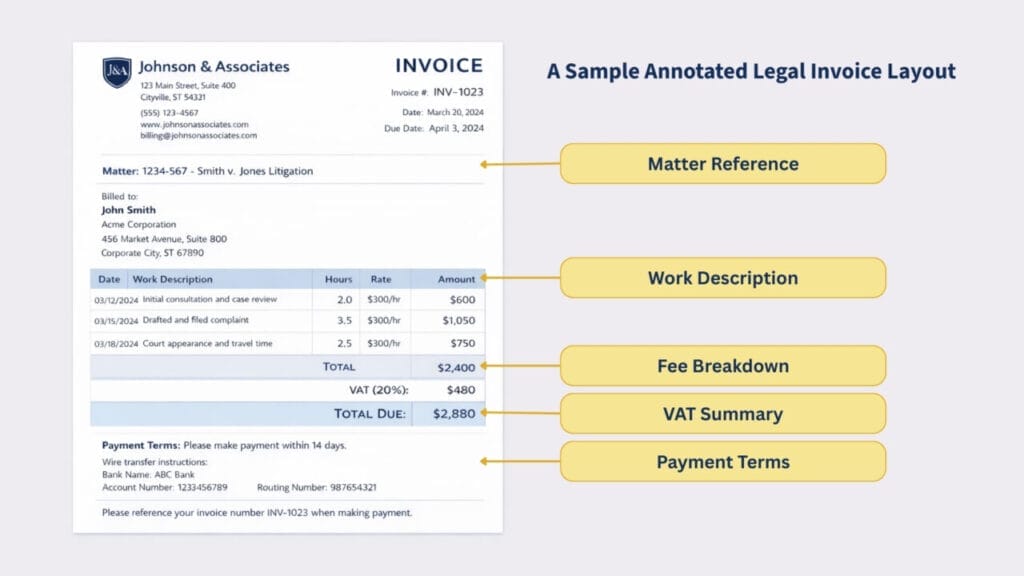
An effective legal billing invoice is not simply a list of time entries. It is a professional document that communicates value, reinforces trust, and makes paying easy. Here is what every strong legal invoice should contain.
Every invoice should clearly state the client’s name and address, the matter reference number, and the relevant date range. This sounds obvious, yet many firms still issue invoices that make it difficult to identify which matter — or even which solicitor — the charge relates to.
This is where most legal invoices fall short. Time recording entries copied directly into an invoice — written for internal use rather than for a client — are rarely clear or persuasive.
Instead of writing: ‘Attending to correspondence and telephone attendances — 2.4 hours’
Write: ‘Reviewing and responding to correspondence from opposing solicitors regarding the boundary dispute; advising you by telephone on settlement options and next steps — 2.4 hours’
Specific descriptions connect the fee to identifiable actions, reduce the likelihood of disputes, and help clients feel informed rather than invoiced.
Clearly show your hourly rate (or fixed fee basis), the time recorded, and how the total is calculated. If disbursements are included — court fees, search fees, counsel’s fees — list them separately and provide a brief explanation of what each one represents.
SpineLegal’s legal billing software is designed to support firms in producing itemised, client-friendly invoices that meet SRA billing requirements — without adding hours of administrative work.
Where applicable, your invoice must include your VAT registration number, the VAT rate applied, and the VAT amount charged. This is both a legal requirement under HMRC’s rules for VAT invoices and a practical step that enables business clients to reclaim input tax promptly.
Tell the client exactly how to pay, when to pay, and what happens if they do not. Your invoice should include your firm’s bank account details (or a secure online payment link), the payment due date, and a brief, professional statement of your late payment policy.
Firms that display a specific due date — rather than simply ‘payable within 30 days’ — consistently see faster settlement. ’14 days from the date of this invoice’ is concrete; ‘within 30 days’ requires the client to do mental arithmetic they may never get around to.
The timing of your legal billing invoices has a direct impact on payment rates. Best practice for most transactional and litigation matters is to bill regularly — either monthly or at defined milestones — rather than issuing a single large invoice at the end of the matter.
Billing regularly has several advantages:
For longer or more complex matters, interim billing is not only good cash flow management — it is good client service. Consider using SpineLegal’s time recording and billing features to set up automatic invoice schedules tied to matter milestones.
Your payment terms should be agreed with the client at the outset — not introduced for the first time on an invoice. Under the SRA’s transparency rules, clients must be informed about fees and payment expectations during the client care process.
Consider the following when setting your terms:
When clients understand and have agreed to the terms upfront, they are far less likely to dispute or delay payment when the invoice arrives. Clear terms also strengthen your position if recovery action ever becomes necessary.
For many solicitors, the billing process is time-consuming precisely because it is manual. Time entries are recorded on paper or in spreadsheets, then re-typed into a billing document, checked, formatted, and sent. At each stage, there is scope for delay and error.
Modern legal practice management software — including SpineLegal’s billing and invoicing tools — automates much of this process. Time recorded during the matter flows directly into draft invoices, which can be reviewed, adjusted, and sent from a single interface. This not only saves time; it reduces the lag between completing work and issuing the invoice.
Key features to look for in legal billing software include:
The SRA’s latest practice management guidance encourages firms to adopt systems that improve financial transparency and client service. Investing in the right technology is increasingly less of an overhead and more of a competitive advantage.

Legal invoices have a reputation for being cold and bureaucratic — full of Latin phrases, internal references, and impenetrable abbreviations. While professional standards must be maintained, there is no reason a legal invoice cannot also be clear, respectful, and client-focused.
A few practical principles for invoice language:
A brief, personalised covering note — or a brief introduction paragraph at the top of the invoice — can make a significant difference to how the document is received. Clients who feel informed and respected are more likely to pay promptly and to return.
Even with a well-structured legal billing process, some invoices will not be paid on time. Having a consistent, professional escalation process reduces the awkwardness and protects the relationship where possible.
A simple framework:
Throughout this process, keep records of all communications. If the matter ever proceeds to a costs assessment or small claims action, a documented trail significantly strengthens your position.
For more guidance on managing client disputes and your obligations under the SRA Standards and Regulations, visit the SRA’s website for up-to-date professional conduct resources.
Improving your legal billing process is one of the highest-return operational changes a small law firm can make. Clearer descriptions, timely dispatch, agreed payment terms, and the right technology all contribute to invoices that clients understand — and pay.
The goal is not simply to reduce debt recovery headaches. It is to create a billing experience that is consistent with the professional, client-centred service your firm already delivers in its legal work.
SpineLegal’s practice management tools are built specifically for solicitors and law firms. Explore our legal billing and invoicing features — or learn more about how SpineLegal supports compliance with the SRA’s transparency requirements.
Under the SRA Standards and Regulations, solicitors must provide clients with clear information about costs, including the basis of the fees charged, any disbursements, and the VAT treatment. A compliant legal invoice should include the client’s name and matter reference, an itemised breakdown of work carried out, the fee earner’s hourly rate (or fixed fee basis), disbursements listed separately, VAT registration number and VAT summary, and clear payment terms. You should also ensure clients have received a costs estimate and client care letter at the outset of the matter. Legal practice management software such as SpineLegal can help law firms generate compliant invoices by automatically pulling matter details, time entries, and disbursements into structured billing templates.
Effective billing descriptions should move away from internal shorthand and instead explain specifically what was done, why, and what outcome it achieved for the client. Rather than ’emails and calls’, write ‘corresponding with the other side’s solicitors regarding the settlement terms and advising you on the revised offer received’. Plain English, specific activity, and a client-facing perspective all improve both comprehension and the likelihood of prompt payment. SpineLegal capture time entries and activities clearly so that billing descriptions are easier to translate into client-friendly explanations.
Yes. Under the Late Payment of Commercial Debts (Interest) Act 1998, law firms are entitled to charge statutory interest on overdue business-to-business invoices. The current statutory rate is 8% above the Bank of England base rate. For consumer clients, interest provisions must be clearly stated in your client care letter and terms of engagement. It is advisable to include your interest policy in your standard terms and to reference it on each invoice.
For most matters, monthly or milestone-based billing is considered best practice. Regular billing keeps clients informed of accruing costs, reduces end-of-matter surprises, and improves the firm’s cash flow. Particularly for contentious matters or complex transactions that run over several months, interim bills should be issued with the client’s agreement, as confirmed in the initial client care documentation.