Time is a law firm’s most valuable — and most wasted — resource. Across the profession, solicitors and legal teams spend enormous portions of their working week on tasks that are necessary but deeply repetitive. Drafting standard documents, conducting background research, summarising lengthy case files, chasing signatures — none of these tasks require the depth of legal expertise your clients pay for.
AI legal software is changing that. It is not a distant promise or an experimental concept. Today, platforms like SpineLegal are already helping law firms automate the work that drains time and focus — freeing legal professionals to concentrate on high-value, billable activity.
The result? Firms consistently report reclaiming 20 or more hours every single week. That figure is not a marketing claim. It reflects what happens when intelligent automation handles drafting, research, summarisation, compliance checks, and email writing at scale.
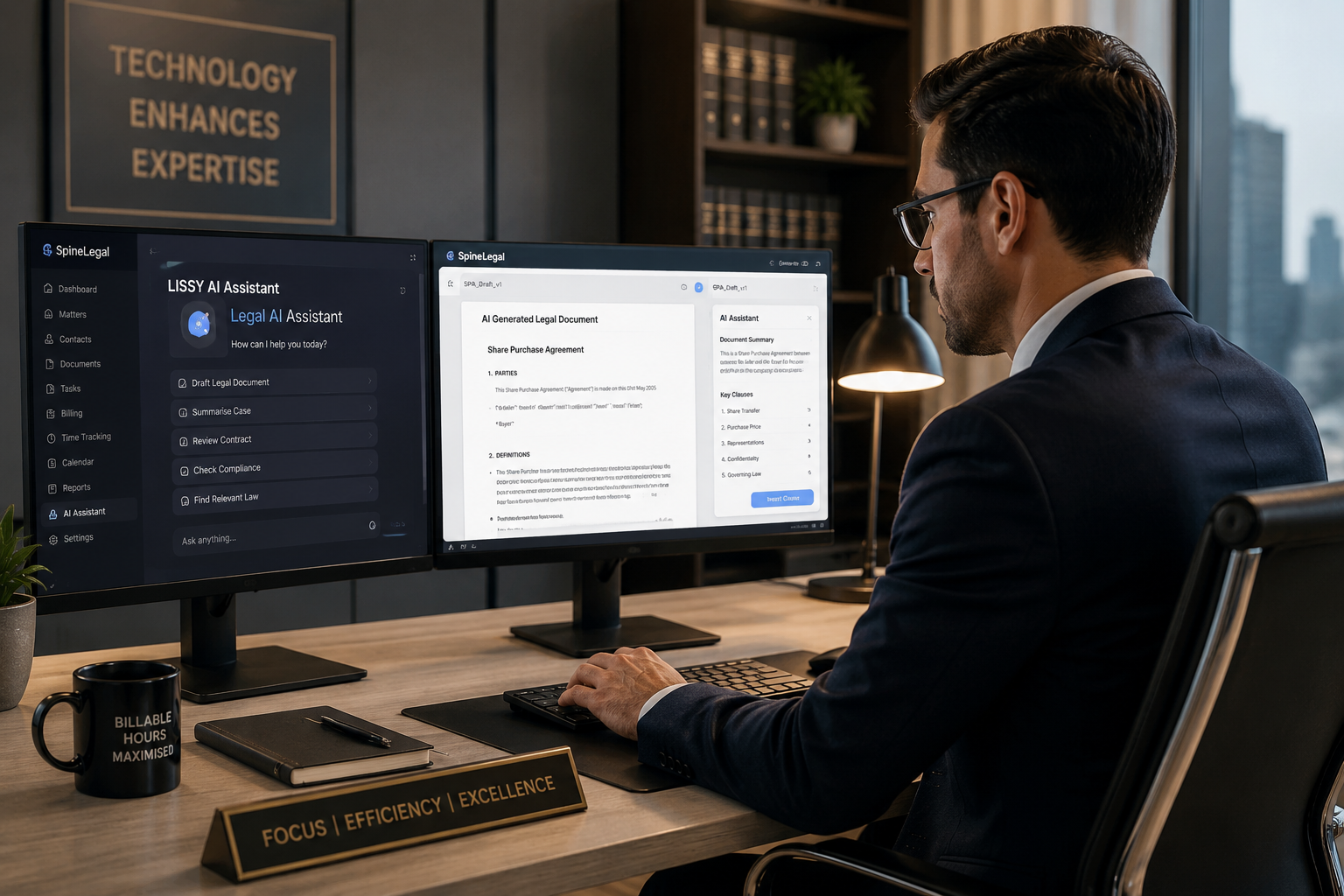
Most law firms, particularly smaller practices, operate with lean teams. Fee earners carry a dual burden: delivering legal expertise whilst also managing administrative and operational tasks.
Consider a typical week. A solicitor might spend two hours drafting a client care letter from scratch. They might then spend another hour reviewing a lengthy contract before summarising it for a client. Add in legal research, internal emails, compliance logging, and chasing outstanding documents — and suddenly a significant portion of chargeable time has evaporated.
According to research from the Law Society, fee earners spend only around 60–65% of their time on billable work. The remainder is consumed by administrative tasks — many of which are prime candidates for automation.
However, the solution is not simply working harder or longer. Instead, it lies in working smarter — specifically, by integrating AI legal tools that absorb the repetitive load.
SpineLegal is built specifically for legal professionals. Therefore, its features are grounded in how firms actually operate — not in generic productivity concepts. Each AI tool within the platform targets a distinct bottleneck in legal workflows.
Here is how each tool delivers measurable time savings.
Legal professionals read constantly. Case files, lengthy contracts, research papers, court judgments — the volume of text is relentless. SpineLegal’s AI Summary tool condenses lengthy documents into structured, accurate summaries within seconds.
For example, a 40-page commercial lease that might take 90 minutes to review manually can be summarised in under two minutes. Additionally, the summaries are formatted to highlight key clauses, obligations, and risk areas — precisely the information a solicitor needs before advising a client.
This tool alone can save four to six hours per week for a busy fee earner.
Legal research is essential. It is also time-consuming. SpineLegal’s Legal Research tool enables lawyers to query complex legal questions and receive contextually relevant, jurisdiction-aware results — without hours spent on manual database searches.
Rather than toggling between multiple legal databases, solicitors can input a query directly into SpineLegal and receive synthesised, relevant guidance immediately. Furthermore, research results are presented in plain, structured language that can be incorporated directly into advice letters or case notes.
For a small firm handling varied caseloads, this can eliminate three to five hours of research time weekly.
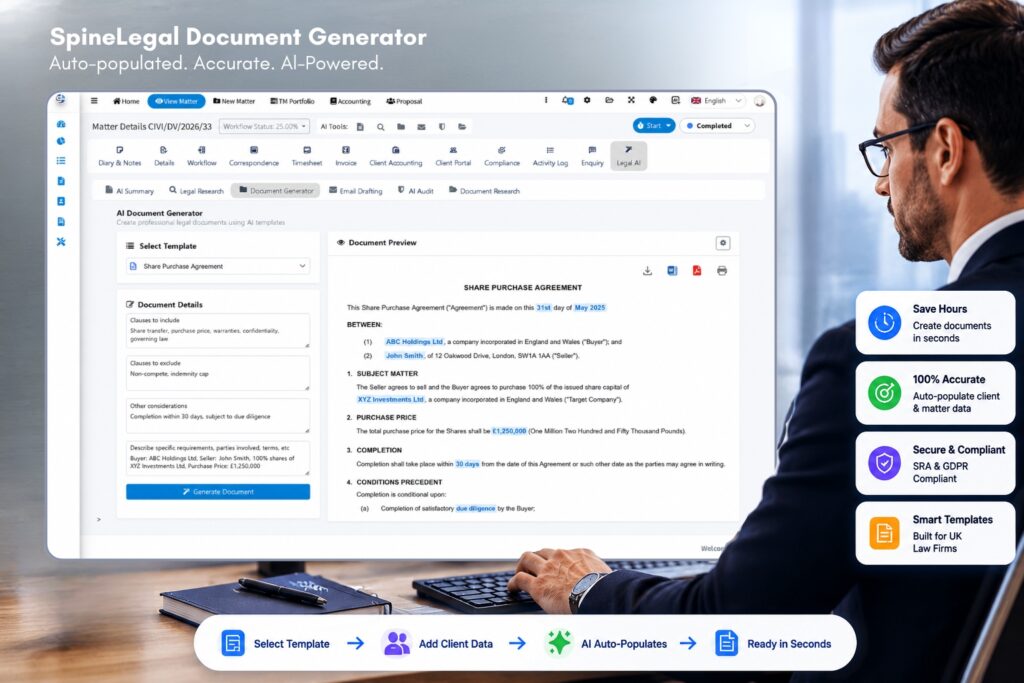
Document drafting is one of the most consistent time drains in legal practice. SpineLegal’s Document Generator allows firms to produce accurate, professionally formatted legal documents from intelligent templates.
Whether it is a non-disclosure agreement, a letter of engagement, a will, or a contract for services — the Document Generator pulls in the relevant client data and produces a draft that is ready for review. Consequently, what once took a paralegal an hour now takes fewer than five minutes.
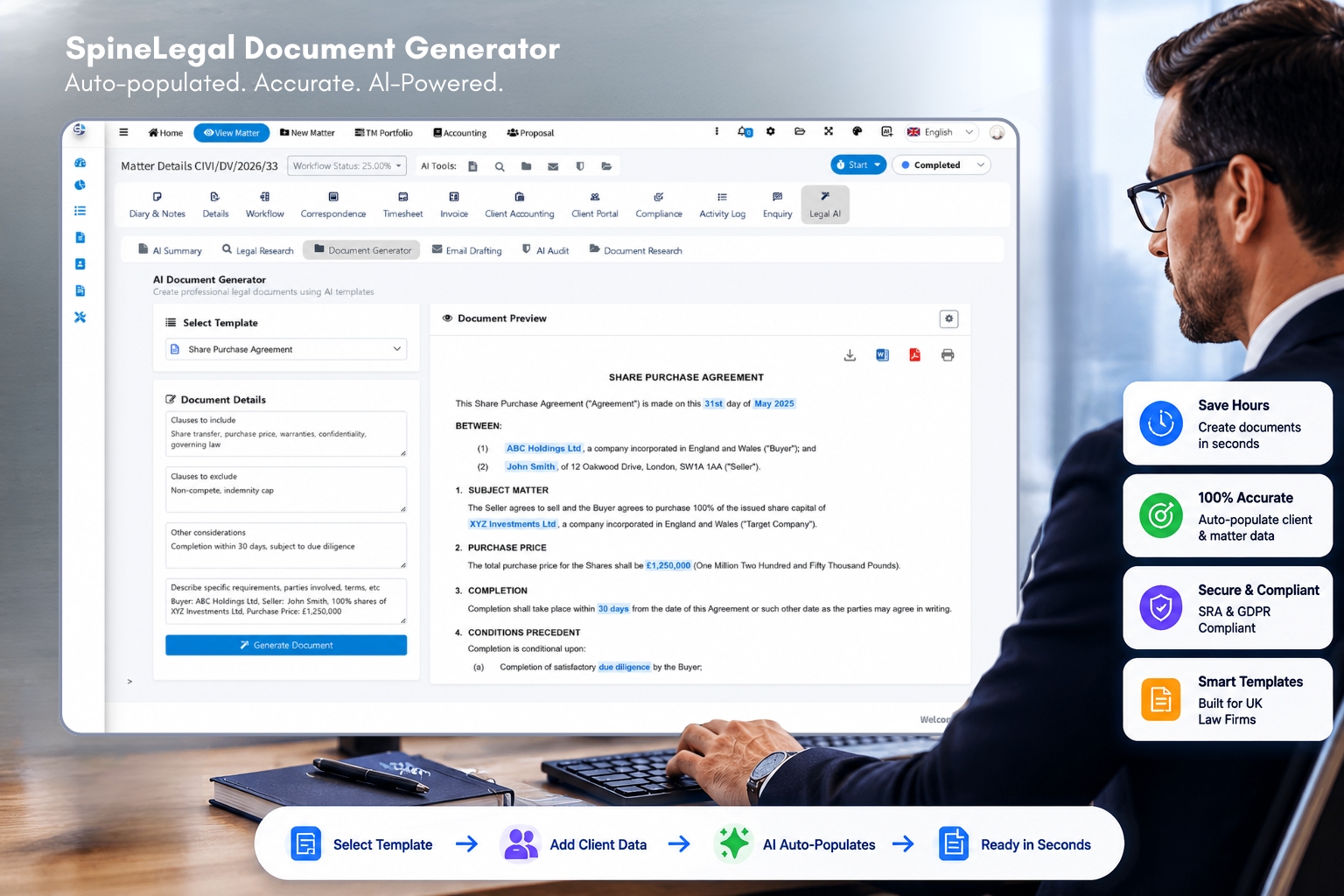
Moreover, documents are consistent. There is no risk of a fee earner accidentally using an outdated precedent or omitting a standard clause. Every draft adheres to the firm’s approved templates.
Legal professionals write dozens of emails daily. Client updates, inter-party correspondence, internal instructions — each one requires care, precision, and a professional tone. SpineLegal’s Email Drafting tool generates polished, context-aware emails in seconds.
A solicitor simply inputs the key points they want to communicate. The tool then structures a clear, professional email — using appropriate legal language and maintaining the firm’s tone of voice. Therefore, fee earners spend less time staring at blank screens and more time moving matters forward.
For a team of four fee earners, email drafting automation can recover up to three hours per week across the team.
Compliance is non-negotiable in legal practice. Yet compliance reviews are often reactive, rushed, and stress-inducing. SpineLegal’s AI Audit tool changes this dynamic entirely.
The AI Audit continuously monitors documents and workflows for compliance gaps. It flags issues proactively — before they become regulatory concerns. Firms can therefore approach compliance reviews with confidence rather than anxiety.
According to the International Bar Association, regulatory risk is one of the primary concerns for legal practices globally. Automating compliance checks not only reduces risk — it reduces the time partners spend manually reviewing files for compliance issues, which can consume two to four hours weekly.
Beyond summaries, SpineLegal’s Document Research tool enables in-depth analysis of complex documents. It cross-references clauses, identifies inconsistencies, and surfaces relevant precedents — tasks that traditionally require significant senior lawyer time.
This tool is particularly valuable in due diligence, contract negotiation, and dispute resolution contexts. For instance, during a commercial transaction, a solicitor can run a full document research query on a suite of transaction documents and receive a structured analysis report in minutes. Meanwhile, the solicitor can be advancing other aspects of the matter.
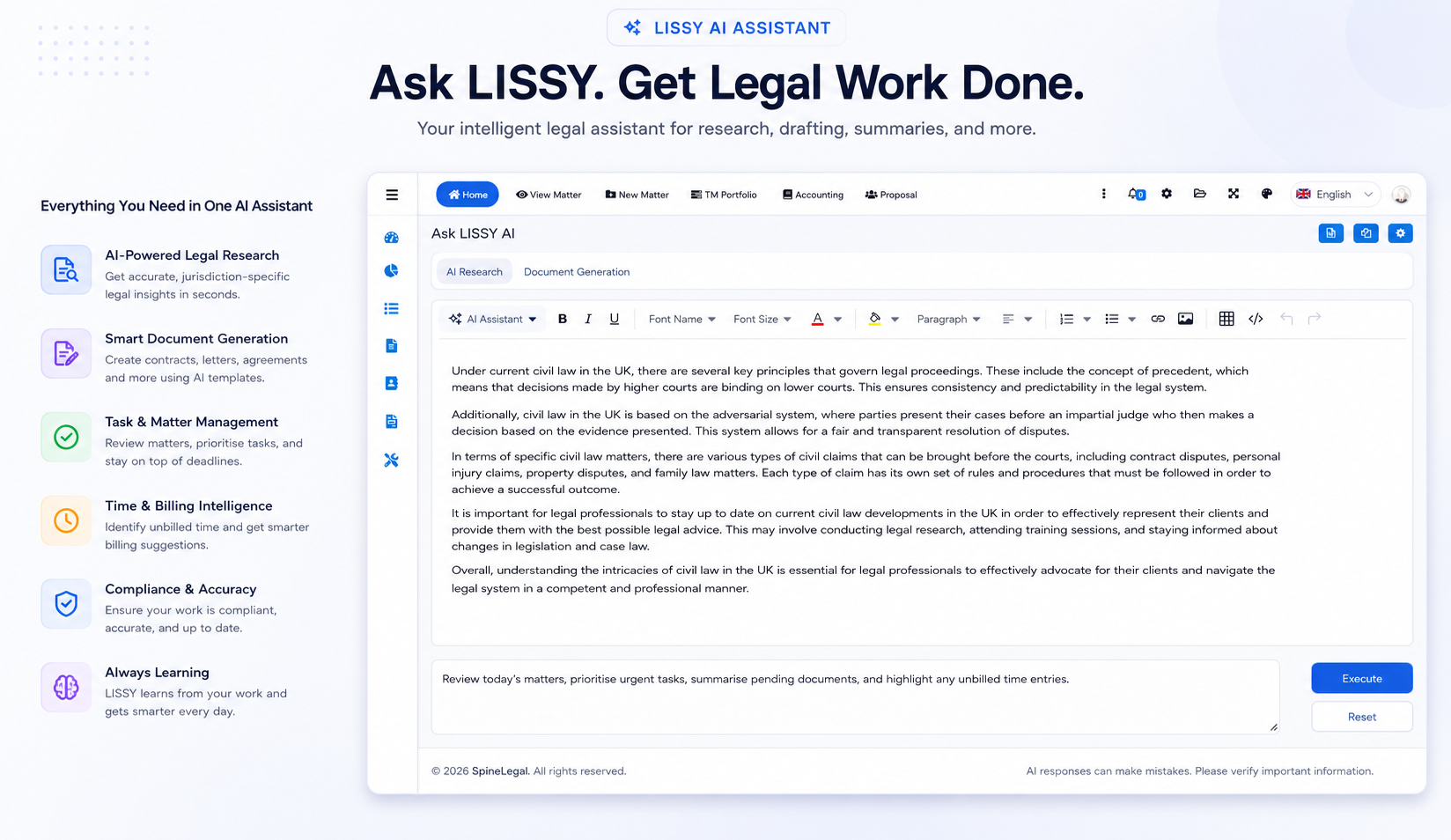
Underpinning all of SpineLegal’s tools is LISSY, the platform’s intelligent AI assistant. LISSY does not simply respond to individual queries — it coordinates across tasks, learns from firm-specific preferences, and proactively supports workflow progression.
Here are three practical examples of LISSY in action:
Automated task creation: When a new matter is opened, LISSY automatically generates a structured task list based on matter type. For a residential conveyancing matter, LISSY creates tasks for searches, client ID checks, draft contracts, and completion day logistics — without a fee earner manually entering each step.
Instant document summaries on upload: When a client uploads a document — such as a lease or a share purchase agreement — LISSY immediately processes the file and delivers a concise summary to the fee earner’s dashboard. Therefore, the solicitor is informed before the client even sends a follow-up email.
Billing trigger automation: As tasks are completed within SpineLegal, LISSY flags billable activities and prompts time recording entries. Consequently, firms capture more billable time without requiring fee earners to maintain meticulous manual logs.
It is tempting to view each tool’s time saving in isolation. However, the real power of SpineLegal’s AI legal software lies in the cumulative effect across the entire practice.
Consider a firm with five fee earners. If each saves just four hours per week through a combination of AI Summary, Email Drafting, and Document Generator — that is 20 hours recovered every week. Over a month, that is 80 hours. Over a year, it is nearly 1,000 hours of recovered capacity.
That recovered time is not idle. It translates directly into additional client matters, improved turnaround times, and stronger client relationships.
Adopting AI legal software does not require a lengthy implementation project. SpineLegal is designed for rapid deployment. Most firms are operational within days, not months.
The onboarding process covers:
Furthermore, SpineLegal provides dedicated support throughout the onboarding phase. Firms are not left to configure the system alone.
Law firms that adopt AI legal tools now are building a structural advantage over those that do not. Clients increasingly expect faster turnaround times, clearer communication, and transparent pricing. AI software directly enables all three.
Additionally, staff retention improves when fee earners are freed from repetitive administrative work. Legal professionals enter the profession to practise law — not to spend afternoons manually formatting documents. Reducing that burden improves morale, reduces burnout, and supports talent retention.
The firms that will lead their sectors in three years are those that are adopting smart automation today.
SpineLegal is purpose-built for legal professionals who want to work smarter. Whether you manage a sole practice or a growing multi-fee-earner firm, the platform scales to your needs.
Explore SpineLegal’s full suite of AI legal tools and discover how much time your firm could recover.
See LISSY and SpineLegal’s AI tools in action — tailored to your firm’s practice areas and workflows.
Book your free meeting with the SpineLegal team →
There is no commitment and no technical setup required. Simply bring your questions — and leave with a clear picture of how AI legal software can transform your practice.
Q: Is AI legal software suitable for small law firms? AI legal software is particularly well-suited to small and mid-sized firms. Smaller practices often have fewer administrative staff, meaning fee earners absorb more non-billable work. SpineLegal’s tools are designed to reduce that burden immediately — without requiring a dedicated IT team to manage the platform.
Q: How does AI legal software handle confidential client data? SpineLegal is built with data security at its core. All documents and client information processed through the platform are encrypted and handled in accordance with applicable data protection standards. Firms retain full control over their data at all times.
Q: Can AI tools like SpineLegal replace legal professionals? No — and they are not designed to. AI legal software automates repetitive, time-consuming tasks so that solicitors can focus on complex legal reasoning, client relationships, and strategic advice. The technology supports legal professionals; it does not replace their expertise or judgement.
Q: How quickly can a law firm start saving time with SpineLegal? Most firms begin seeing time savings within the first week of adoption. The Document Generator and AI Summary tools deliver immediate value from day one. As LISSY learns firm-specific preferences and workflows, the efficiency gains compound over time.
SpineLegal — AI Legal Software Built for the Way Lawyers Work. Explore SpineLegal | View AI Features | Book a Demo