
AI tools for attorneys are no longer a distant prospect — they are reshaping legal practice right now. From automating document drafts to accelerating case research, the efficiency gains are undeniable. However, adoption without structure creates serious professional risk. Attorneys must understand not only what these tools can do, but how to use them whilst remaining firmly within their ethical obligations. This guide examines each of SpineLegal’s core AI features and offers practical, compliance-focused guidance for modern legal practitioners.

The legal profession is built on trust. Clients rely on attorneys to act with precision, confidentiality, and competence. Therefore, introducing AI into a legal workflow is not simply a technology decision — it is a professional responsibility decision.
Bar associations and regulatory bodies globally are developing guidance on AI use in legal practice. The American Bar Association’s resources on AI and legal practice highlight that competence now encompasses an understanding of relevant technology. Similarly, regulators in other jurisdictions are moving in the same direction.
Moreover, attorneys must consider duties of confidentiality, supervision of non-lawyer work, and candour to tribunals — all of which interact with AI-generated output. The question, therefore, is not whether to use AI, but how to use it responsibly.
Key Principle
AI tools augment attorney judgement — they do not replace it. Every output must be reviewed, verified, and owned by a qualified legal professional.
SpineLegal provides a suite of six AI-powered tools designed specifically for legal professionals. Each one carries distinct ethical considerations. Understanding these is essential before integrating them into client-facing work.
The AI Summary tool condenses lengthy legal documents, case files, and correspondence into structured overviews. This dramatically reduces the time attorneys spend on preliminary review. However, accuracy is paramount.
Summaries generated by AI must never be presented to clients or courts as a definitive representation of a document’s contents without human verification. Additionally, attorneys should be cautious about summarising documents that contain ambiguous clauses or jurisdiction-specific nuance — areas where AI may flatten critical distinctions.
Best practice: Use AI summaries as a first-pass tool only. Always cross-reference key passages against the original document before advising clients or drafting submissions.
Legal research is time-intensive and expensive. The Legal Research tool accelerates case identification, statute analysis, and precedent mapping significantly. Nevertheless, attorneys must apply professional scepticism to every result.
AI-generated legal research can miss jurisdiction-specific rulings, misattribute authority, or fail to capture recent legislative changes. Therefore, it should always be treated as a starting point, not a conclusion.
The Law Society’s guidance on technology in law reinforces that professional responsibility for accuracy remains entirely with the practitioner, regardless of the tools used.
The Document Generator enables attorneys to produce draft contracts, letters, and legal instruments from templates enriched by AI. This is particularly valuable for high-volume transactional work and small firms managing large caseloads.
However, automated drafts require careful supervision. AI cannot fully account for client-specific circumstances, negotiated deviations from standard terms, or jurisdiction-specific enforceability requirements. Furthermore, data entered into document generation prompts must be treated with the same confidentiality obligations as any client file.
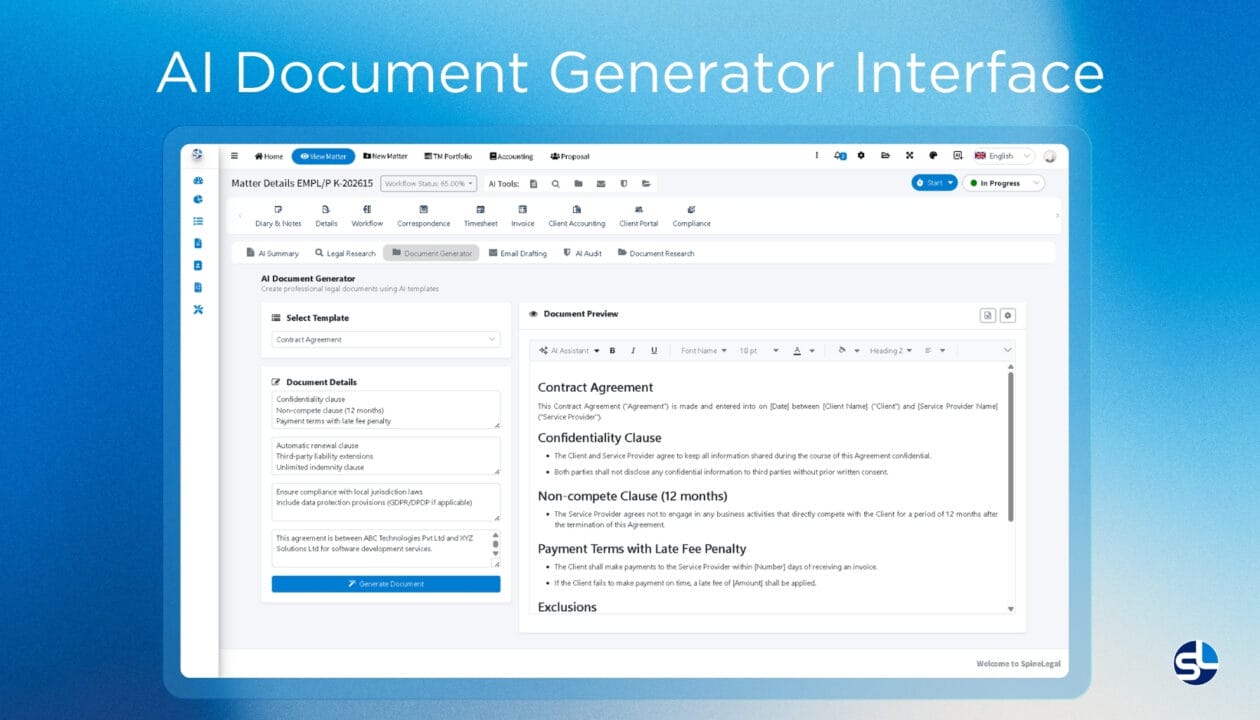
Best practice: Treat every AI-generated document as a first draft. Conduct a thorough review against client instructions, applicable law, and internal precedents before issuing any document externally.
Effective communication is central to legal practice. The Email Drafting tool assists attorneys in producing clear, professionally-worded correspondence quickly. This is especially useful during high-volume periods or for drafting routine communications.
Nevertheless, attorneys must review all AI-drafted emails before sending. Tone, accuracy of legal positions, and appropriate disclosure requirements cannot be safely delegated to an AI model without review. Additionally, emails that contain legal advice or strategic positions must reflect the attorney’s genuine, considered view — not an AI approximation of it.
Best practice: Use the drafting tool for structure and language assistance. Always confirm that the legal substance and tone accurately represent your considered advice before dispatch.
The AI Audit tool is arguably the most important feature for ethically conscious practitioners. It enables attorneys to review AI-generated outputs for accuracy, consistency, and potential errors before they enter client-facing work.
Building an audit step into every AI-assisted workflow is not merely good practice — it is a professional obligation. Supervision of AI output is analogous to supervising the work of a junior associate. Ultimately, the attorney’s name on the matter means full accountability for the work product.
Compliance NoteThe AI Audit tool supports attorneys in meeting their duty of competence by providing a structured review layer between AI generation and client delivery.
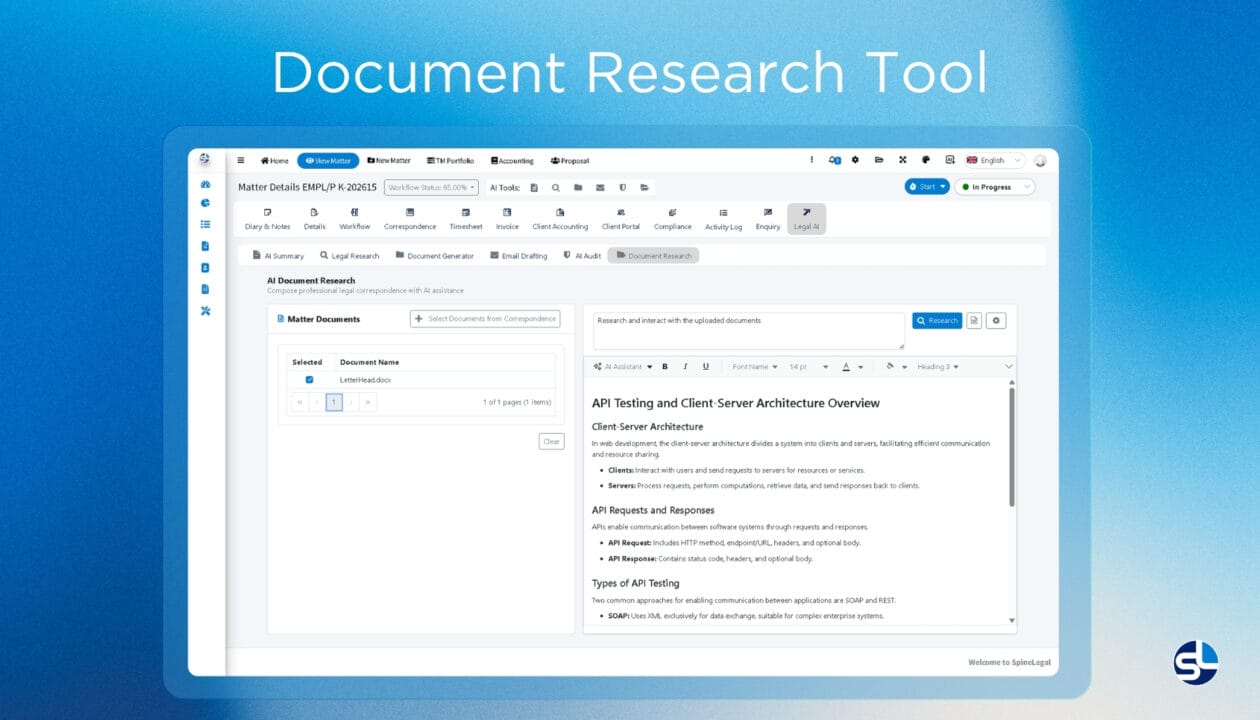
The Document Research tool enables attorneys to analyse uploaded documents — contracts, court filings, discovery materials — and extract key provisions, identify risks, and surface relevant clauses efficiently. This is particularly powerful for due diligence, contract review, and complex litigation support.
However, AI-driven document analysis can misinterpret ambiguous language or fail to grasp the commercial intent behind specific provisions. Therefore, the attorney must bring legal and contextual judgement that the AI cannot replicate.
Best practice: Use Document Research to surface relevant clauses rapidly. Then apply professional judgement to interpret those clauses in the context of your client’s specific position and objectives.
Individual tool-level awareness is necessary but insufficient. Firms should build a firm-wide ethical AI framework that governs how these tools are introduced, monitored, and refined over time. Here is a practical structure to consider.
Every firm using AI tools should have a written policy covering: which tools are approved for use, what types of matters they may be applied to, how outputs must be reviewed, and who is responsible for oversight. This policy should be reviewed regularly as tools evolve.
AI tool competence must extend across the firm. Paralegals, associates, and trainees using these tools without appropriate training create liability exposure. Therefore, structured onboarding and ongoing training are essential. SpineLegal’s resources section offers guidance to support this process.
Data entered into AI tools must be treated with the same rigour as any privileged communication. Attorneys should ensure that the platforms they use operate with appropriate data security standards and clear data processing agreements. Verify the platform’s data handling policy before uploading any client-identifiable information.
If a complaint or dispute arises, demonstrating that AI was used as a supervised, audited tool — rather than a replacement for professional judgement — can be critical. Accordingly, firms should maintain records of how AI tools contributed to matter work and what review steps were taken.
Regulatory bodies are paying close attention to AI in legal practice. Several jurisdictions have issued or are developing formal guidance specifically addressing the use of AI tools by practising attorneys. Meanwhile, courts in various jurisdictions have introduced specific rules requiring disclosure when AI has been used in preparing court documents.
This regulatory attention is accelerating. Attorneys who build ethical AI practices now will be well-positioned as compliance expectations formalise. Conversely, those who adopt AI without governance frameworks risk professional sanctions and reputational damage.
SpineLegal’s legal technology blog tracks regulatory developments and provides updated guidance to help firms stay ahead of these changes.
The central principle in every consideration above is this: AI enhances legal practice, but it does not practise law. The attorney’s professional judgement, ethical obligation, and accountability to the client cannot be outsourced to any technology platform.
Used correctly, SpineLegal’s suite of AI tools — AI Summary, Legal Research, Document Generator, Email Drafting, AI Audit, and Document Research — can meaningfully improve the efficiency, consistency, and quality of legal work. Used carelessly, they introduce risk at every stage of the client relationship.
Therefore, the most valuable attribute an attorney can bring to AI-assisted practice is not technical fluency — it is professional rigour. Adopt the tools. Apply the standards. Deliver the quality your clients deserve.
Ready to Use AI the Right Way?
See how SpineLegal’s ethically designed AI tools can integrate into your practice — with full compliance confidence.
Q1. Are AI tools for attorneys ethically permissible under professional conduct rules?
Yes — in most jurisdictions, AI tools are permissible provided attorneys maintain competence, supervise all AI-generated output, preserve client confidentiality, and do not misrepresent AI work as their own independent analysis. The key obligation is that the attorney remains fully responsible for any work product delivered to clients or courts, regardless of how it was produced.
Q2. How does the AI Audit tool help with legal ethics compliance?
SpineLegal’s AI Audit tool provides a structured review layer that allows attorneys to check AI-generated content for errors, inconsistencies, and inaccuracies before it reaches clients. This directly supports the duty of competence and supervision, helping firms demonstrate that AI was used as an audited, professionally overseen resource rather than an unreviewed shortcut.
Q3. Can AI legal research tools replace traditional legal research methods?
No. AI legal research tools significantly accelerate the research process, but they cannot replace the professional judgement required to evaluate authority, assess jurisdiction-specific applicability, and verify that cases remain good law. Attorneys should treat AI research outputs as a starting point and always conduct independent verification of any authority before relying on it in submissions or client advice.
Q4. What should a law firm’s AI policy include to remain ethically compliant?
A compliant law firm AI policy should cover: approved tools and their permitted use cases, mandatory human review requirements for all AI outputs, data confidentiality protocols for information entered into AI platforms, training requirements for all staff using AI tools, audit and documentation procedures, and a process for reviewing and updating the policy as technology and regulations evolve.

