
Running a law firm without a law firm operations manual is like navigating complex litigation without a case strategy — technically possible, but unnecessarily risky. Whether you lead a sole practice or manage a growing team of solicitors, a well-constructed operations manual is the backbone of consistent, compliant, and scalable service delivery.
This guide walks you through exactly what to include, how to structure it, and how to get started — practically, without jargon.
Why Every Law Firm Needs an Operations Manual
An operations manual is not a bureaucratic formality. It is a living document that captures how your firm functions — from client onboarding to file closure, billing protocols to data handling.
Without one, your firm is vulnerable to:
- • Inconsistent client service that damages reputation
- • Staff turnover that takes institutional knowledge with it
- • Compliance gaps that attract regulatory scrutiny
- • Operational bottlenecks that limit growth
With one, you gain a foundation for delegation, training, auditing, and scalability. It becomes the single source of truth for everyone in the firm.

What Is a Law Firm Operations Manual?
A law firm operations manual is a comprehensive internal document — or collection of documents — that defines your firm’s processes, policies, standards, and procedures. It covers both the legal work your firm does and the business operations that support it.
It is distinct from a staff handbook (which focuses on employment conditions) and a compliance manual (which addresses regulatory obligations specifically). The operations manual brings all of these threads together into one cohesive framework.
Think of it as your firm’s institutional memory — the answer to the question: “How do we do things here?”
Core Sections to Include in Your Operations Manual
1. Firm Overview and Values
Start with the foundations. This section should articulate:
- • Your firm’s mission and values
- • Organisational structure and reporting lines
- • Key contacts and role responsibilities
- • Overview of practice areas and service delivery model
This is not window dressing. When a new solicitor or paralegal joins the firm, understanding its culture and structure shapes how they interpret every policy that follows.
2. Client Intake and Onboarding Procedures
Client onboarding is where your firm’s reputation is first formed. This section must cover:
- • Initial enquiry handling and response time standards
- • Conflict of interest checks
- • Client identity verification and AML (anti-money laundering) compliance
- • Client care letters and engagement terms
- • Matter opening procedures and file creation
Formalising these steps ensures every client receives a consistent, professional experience — and that your firm meets its regulatory obligations from the outset. For a deeper look at how technology can streamline this process, explore SpineLegal’s legal workflow automation tools designed for modern legal practices.
3. Matter Management and File Handling
This is the operational core of your manual. It should define:
- • How matters are structured and tracked
- • File naming conventions and document management standards
- • Supervision requirements and escalation procedures
- • Key milestone checklists by practice area (e.g., conveyancing, litigation, corporate)
- • Deadline management and diarising protocols
Standardising matter management reduces the risk of missed deadlines, duplicated work, and costly errors. Firms that invest in purpose-built legal document management software can centralise file storage, enforce naming conventions, and create auditable document trails across every matter.
4. Financial Procedures
Financial management deserves its own dedicated section. Include:
- • Billing and invoicing standards
- • Time recording expectations and software usage
- • Client account procedures (including compliance with accounts rules)
- • Disbursement handling
- • Credit control and debt recovery processes
- • Financial reporting schedules
Time recording expectations and software usage — accurate time capture is foundational to profitable billing and should be a documented standard, not an informal expectation.

5. Compliance and Risk Management
Regulatory compliance is non-negotiable. Your operations manual should include a dedicated compliance section covering:
- • Responsibilities of the Compliance Officer for Legal Practice (COLP) and Compliance Officer for Finance and Administration (COFA)
- • Anti-money laundering (AML) policies and procedures
- • Data protection obligations under applicable data protection legislation
- • Conflict of interest management
- • Complaints handling procedure
- • File review and audit schedules
It is worth referencing authoritative external guidance here. The International Bar Association’s guidelines on law firm management provide a useful global framework for establishing governance standards within legal practices.
For firms operating across multiple jurisdictions, SpineLegal’s compliance management features can help centralise and track regulatory obligations in one place.
6. Human Resources and People Management
This section bridges operations and employment. It should include:
- • Recruitment and onboarding procedures
- • Supervision and performance review processes
- • Training and continuing professional development (CPD) requirements
- • Disciplinary and grievance procedures (referencing your full HR policies)
- • Wellbeing and mental health support provisions
Solicitors and legal staff operate under significant pressure. A firm that documents its people management procedures signals that it takes its duty of care seriously.
7. IT, Data, and Cybersecurity Protocols
Legal data is sensitive data. Your manual must address:
- • Approved software and systems
- • Acceptable use policies for devices and networks
- • Password and access management standards
- • Cybersecurity incident response procedures
- • Remote working protocols
- • Data retention and deletion schedules
A single data breach can cause irreparable client harm and regulatory consequences. Documenting your IT protocols is both a practical and professional necessity.
8. Communication Standards
How your firm communicates internally and externally reflects directly on its professionalism. Include guidance on:
- • Email etiquette and response time expectations
- • Client communication standards (tone, frequency, format)
- • Use of messaging platforms (Teams, Slack, etc.)
- • File sharing and collaboration protocols
- • Social media and marketing conduct guidelines
Client communication standards (tone, frequency, format) — a dedicated client portal can formalise these interactions, giving clients secure, structured access to their matter updates without relying on ad hoc emails.
How to Structure Your Operations Manual
Choose a Format That Works for Your Firm
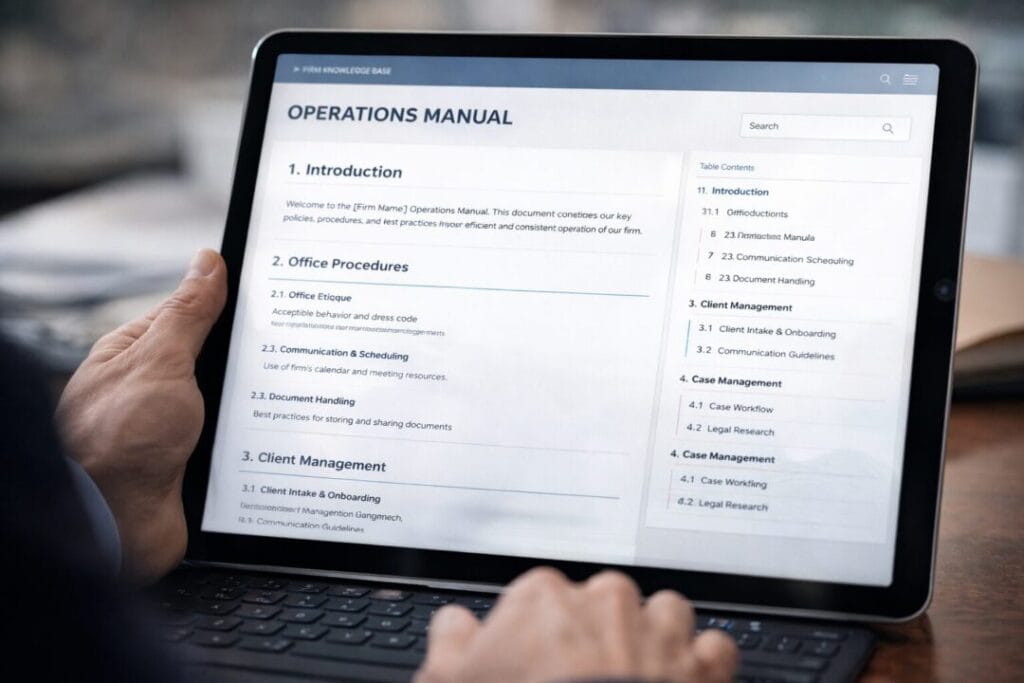
There is no single correct format. Smaller firms often begin with a well-organised shared document (Google Docs, SharePoint, or Notion), while larger practices may use dedicated knowledge management platforms.
What matters is accessibility. Your manual should be:
- • Easy to navigate with a clear table of contents
- • Searchable by keyword
- • Version-controlled so staff always access the current iteration
- • Accessible to the relevant people at all times
Assign Ownership and Review Cycles
Each section of your manual should have a named owner — the person responsible for keeping it current. Without ownership, documents quickly become outdated and lose authority.
Schedule formal reviews at least annually, and trigger interim reviews whenever there is a regulatory change, new system implementation, or significant operational shift.
Start Small, Then Expand
The most common mistake firms make is attempting to document everything at once. The result is an abandoned, half-finished manual that nobody uses.
Instead, prioritise the areas of highest risk or most frequent inconsistency. Client intake and matter management are usually the best starting points. Build from there, section by section, with realistic timelines.
Getting Buy-In From Your Team
An operations manual only delivers value if people use it. Getting team buy-in requires:
- • Involving staff in the drafting process — solicitors who contribute to a procedure are far more likely to follow it
- • Explaining the “why” — connect each policy to a real outcome (client satisfaction, compliance, efficiency)
- • Training on the manual — do not simply publish it and assume it will be read
- • Making it easy to access — embed it into your onboarding process and reference it regularly in team meetings
Firms that treat the manual as a leadership tool rather than a compliance exercise tend to see far stronger adoption.
Using Technology to Support Your Operations Manual
Modern legal technology can do more than store your manual — it can embed your procedures directly into your workflows. Practice management platforms allow you to build intake checklists, matter templates, and compliance reminders that enforce your documented processes in real time.
SpineLegal’s practice management platform is built to support firms in translating their operational frameworks into automated, auditable workflows — reducing the gap between what is documented and what is actually done.
The Law Society also provides guidance on practice management standards that can serve as a useful benchmark when developing your internal procedures.
Keeping Your Manual Relevant Over Time
A law firm operations manual is not a one-time project. It is an ongoing commitment. To keep it relevant:
- • Conduct a formal annual review across all sections
- • Assign a senior team member to monitor regulatory updates and flag changes
- • Create a clear version history so staff can track what has changed and when
- • Solicit staff feedback on where procedures feel unclear or unworkable
A manual that evolves with the firm is an asset. One that sits unchanged for years becomes a liability.
FAQ
What is a law firm operations manual? A law firm operations manual is an internal document that defines your firm’s processes, procedures, and standards across all operational areas — from client intake and matter management to compliance, finance, and IT. It serves as the authoritative guide for how your firm functions on a day-to-day basis.
How long should a law firm operations manual be? There is no fixed length. A sole practitioner may maintain a concise manual of 20–30 pages covering core procedures, while a mid-sized firm may operate with a suite of documents totalling several hundred pages. Substance and usability matter more than volume.
How often should a law firm operations manual be reviewed? At a minimum, conduct a comprehensive review annually. You should also trigger interim reviews following regulatory changes, system upgrades, or significant changes in firm structure or service delivery.
Where should a law firm store its operations manual? The manual should be stored in a centralised, searchable, and access-controlled platform — whether that is a practice management system, an intranet, or a document management tool such as SharePoint or Notion. Accessibility and version control are the two most important factors.
Ready to Operationalise Your Law Firm?
SpineLegal helps law firms turn documented procedures into automated, auditable workflows — reducing admin time by up to 60% and eliminating the gap between what is written in your manual and what actually happens on the ground.
- ✅ Built-in compliance tracking and audit trails
- ✅ Automated client intake and matter workflows
- ✅ Time recording, billing, and accounts in one platform
- ✅ Secure document management and client portal
- ✅ No obligation — free demo, same-day response
15–30 minute consultation · No obligation · Same-day response guaranteed

