
Billing errors are one of the most preventable — and most damaging — causes of bar complaints against legal professionals. When a client questions an invoice and does not receive a satisfactory explanation, frustration escalates quickly into a formal complaint. For solicitors and small law firms, the consequences can be severe: disciplinary proceedings, reputational damage, and even suspension.
This guide is not about theoretical compliance. It is a practical, operational resource to help your firm tighten its billing processes, reduce time entry errors, and maintain the kind of billing transparency that keeps clients confident and regulators at bay.
Why Billing Errors Lead to Bar Complaints
Bar complaints related to billing are rarely about large, obvious fraud. More often, they stem from small, recurring issues: vague time descriptions, duplicate entries, overbilling for administrative tasks, or invoices that simply do not match a client’s understanding of the fee agreement.
When clients feel they cannot understand or verify what they are being charged for, trust erodes rapidly. And once trust is gone, a complaint is often the next step.
Common triggers include:
- • Block billing that makes it impossible to assess individual tasks
- • Round-number time entries (billing exactly 0.5 or 1.0 hours consistently)
- • Charging for non-billable tasks such as internal admin or file organisation
- • Failing to honour fixed-fee or capped-fee arrangements
- • Sending invoices with no supporting narrative
- • Delay in billing, followed by a large unexpected invoice
Understanding these triggers is the first step. Eliminating them requires process, oversight, and the right tools.
The Foundation: A Clear and Signed Fee Agreement
Every billing dispute and bar complaint that follows almost always traces back to one moment: the point at which the client and the firm failed to establish a shared understanding of how fees would be calculated.
Your client engagement and fee agreement process must be watertight. The engagement letter or client care letter should clearly state:
- • The billing method (hourly, fixed fee, contingency, or hybrid)
- • The hourly rates for each fee earner who may work on the matter
- • How disbursements will be handled and billed
- • Billing frequency (monthly, upon completion, milestone-based)
- • The process for raising billing queries
Clients who are surprised by an invoice are clients who were not properly informed at the outset. A clearly drafted engagement letter is your first line of defence against both billing disputes and formal bar complaints.
Accurate Time Recording: The Discipline That Protects Your Practice
Poor time recording is the single biggest operational risk in legal billing. When time entries are inaccurate, vague, or inconsistent, you expose your firm to complaints that are very difficult to defend.
Best practice in time recording includes:
Record contemporaneously. Enter time as you complete each task, not at the end of the day or — worse — at the end of the week. Reconstructed time entries are rarely accurate and often impossible to defend if challenged.
Be specific in your narrative. “Drafting correspondence” is not sufficient. “Drafting letter to opposing solicitor re: disclosure obligations under CPR 31.6” gives the client something concrete and verifiable.
Avoid block billing. Combining multiple tasks into a single time entry prevents clients from understanding how their money was spent. Many bar associations consider block billing inherently problematic. Instead, separate each discrete task with its own entry.
Use the right time increments. If your firm bills in six-minute units (0.1 hours), apply that consistently. Rounding up without justification is a common complaint trigger.
Review before you bill. Every invoice should be reviewed by a supervising partner or billing manager before it goes out. Errors caught internally are far preferable to errors caught by a client or regulator.

Common Time Entry Errors and How to Eliminate Them
Understanding the most frequent errors allows you to build targeted safeguards into your billing workflow.
Duplicate entries occur when the same task is recorded twice — often when time is entered at the matter level and again during weekly summaries. A simple billing review checklist can catch these before they reach the client.
Inflated estimates happen when a fee earner rounds up a two-minute phone call to 0.3 hours. Over an entire matter, these small inflations add up significantly. Train your team on what constitutes a billable unit and where rounding is and is not acceptable.
Non-billable tasks billed in error are a particularly serious issue. Internal file reviews, team meetings about matter management, and time spent correcting your own errors are generally not recoverable from the client. Ensure your billing codes and time entry categories make a clear distinction.
Administrative tasks billed at fee earner rates — such as photocopying, filing, or data entry — should either not be billed at all or charged at a separate administrative rate clearly stated in the engagement letter.
Maintaining a living, regularly updated billing policy document and making it accessible to all fee earners is essential. Consistent training reduces error rates significantly over time.
Billing Transparency: Invoices Your Clients Can Actually Understand
An invoice that reads as a wall of legal jargon is an invoice that invites complaints. Your invoices should be designed with the client in mind — not just the billing system.
Practical steps to improve invoice clarity:
- • Use plain language where possible in task descriptions
- • Group related entries under matter stages (e.g., Pre-Action, Disclosure, Trial Preparation)
- • Include a brief narrative summary at the top of each invoice explaining the work done during the billing period
- • Clearly itemise disbursements separately from professional fees
- • If VAT applies, show it as a separate line item
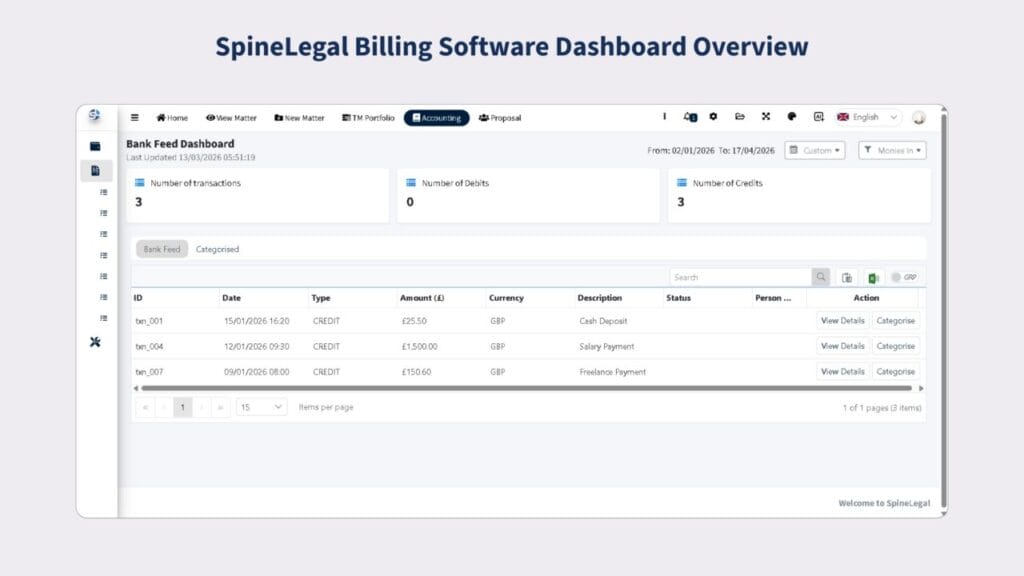
SpineLegal’s legal billing and invoicing tools are designed to support this kind of transparent, client-facing invoice structure — making it easier to produce invoices that are both compliant and comprehensible.
For guidance on professional conduct standards relating to billing, the American Bar Association’s formal ethics opinions on billing provide authoritative reference material applicable across many jurisdictions.
Handling Client Billing Queries Before They Become Complaints
A client who raises a billing query is actually giving you an opportunity. Handle it well and you retain trust. Handle it poorly and you face a formal complaint.
Your firm should have a defined process for responding to billing queries:
- 1. Acknowledge the query in writing within 24–48 hours
- 2. Provide a detailed breakdown of the disputed entries
- 3. If an error is identified, correct it promptly and transparently
- 4. Do not become defensive — approach queries as legitimate concerns
- 5. Document all communications relating to billing disputes
If a client escalates despite your best efforts, having a complete written record of your response process is essential in defending any bar complaint that follows. The Legal Services Board and equivalent regulatory bodies in other jurisdictions consistently emphasise transparency and responsiveness as central to professional conduct in billing matters.
Proactive billing communication — such as sending interim statements or billing updates at agreed milestones — dramatically reduces the likelihood of clients being surprised by a final invoice.
The Role of Technology in Preventing Billing Complaints
Manual billing processes are inherently error-prone. The more steps that depend on individual memory, discipline, or spreadsheet management, the greater the risk of errors reaching a client invoice.
Legal practice management software addresses this directly by:
- • Automating time capture through integrated timers
- • Applying billing rules that flag non-billable task codes
- • Providing pre-billing review workflows with approval gates
- • Generating audit trails for every time entry, edit, and deletion
- • Producing invoices in client-friendly formats automatically
Using a platform built for legal time tracking and billing compliance removes much of the manual burden from fee earners while providing the oversight that senior partners need to maintain billing integrity across the firm.

Building a Billing Compliance Culture Within Your Firm
Technology and process are only effective when the people using them understand why compliance matters. Building a culture of billing accuracy requires investment in training and leadership.
Practical steps to embed billing compliance into your firm’s culture:
- • Conduct quarterly billing audits — review a random sample of invoices from each fee earner
- • Include billing accuracy in performance reviews and appraisals
- • Circulate anonymised examples of billing errors and how they were corrected
- • Hold brief annual training sessions on billing ethics and time entry standards
- • Appoint a billing compliance lead — even in small firms, someone should own this responsibility
The firms that receive the fewest billing-related bar complaints are not necessarily the firms with the fewest errors — they are the firms that catch errors internally and have created an environment where fee earners feel safe flagging mistakes before they reach the client.
Use SpineLegal’s law firm practice management resources to support the operational side of building that culture.
Frequently Asked Questions
What are the most common billing errors that lead to bar complaints? The most frequent triggers include vague time entry narratives, block billing, billing for non-recoverable tasks, failure to honour agreed fee caps, and sending unexpected large invoices without prior communication. Addressing these specific issues through training and billing review processes significantly reduces complaint risk.
How should a law firm respond to a client billing dispute to avoid escalation? Acknowledge the dispute promptly in writing, provide a detailed breakdown of the entries in question, correct any genuine errors transparently, and document every communication. A prompt, professional response to a billing query rarely escalates into a formal bar complaint. Defensiveness or delay significantly increases that risk.
Can billing software genuinely reduce bar complaints? Yes — significantly. Legal billing software reduces manual data entry errors, enforces billing rules, creates approval workflows, and generates audit trails. These features directly address the most common causes of billing inaccuracies that lead to client complaints and regulatory scrutiny.
What should a fee agreement include to prevent billing disputes? At minimum, it should specify the billing method, individual hourly rates, how disbursements are handled, billing frequency, and the process for raising queries. A well-drafted engagement letter is your primary protection against misunderstandings that evolve into formal complaints.
SpineLegal helps law firms and legal professionals manage billing, time tracking, and practice compliance with clarity and confidence. Explore our legal practice management platform to see how we support compliant, transparent billing at every stage of the client matter.
Ready to reduce billing complaints and protect your practice? Book a free consultation with the SpineLegal team and discover how our platform can streamline your billing process, strengthen compliance, and give your clients the transparency they expect.

