

AI legal research tools are no longer a luxury reserved for large commercial practices. Across the UK, small and mid-size law firms are adopting artificial intelligence to overhaul how they prepare cases — and the results are striking. Firms that have integrated AI research platforms into their workflows report reductions in case preparation time of up to 40%, without any compromise to the quality or rigour of their legal analysis.
For a sole practitioner or a firm of five to twenty fee earners, that kind of efficiency gain is transformative. It means fewer late nights before a hearing, fewer missed precedents, and more capacity to take on new clients without increasing headcount.
This article examines precisely how these tools work, where the time savings come from, and what small firms need to consider before adopting them.
Legal research has historically been one of the most time-consuming activities in any practice. A solicitor preparing for a complex commercial dispute, a contested probate matter, or a regulatory compliance review may spend eight to twelve hours researching case law, statutory instruments, and secondary sources — before drafting a single line of advice.
The process typically involves:
Each of these steps demands concentration, legal judgment, and time. In a small firm, that time often belongs to the fee earner who should also be managing client relationships, attending court, and supervising support staff.
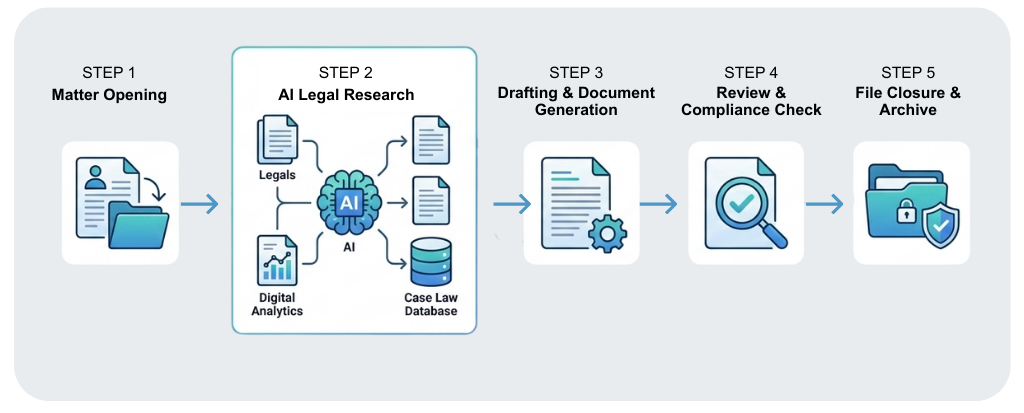
It is important to distinguish Spinelegal AI legal research tools from simple keyword-search databases. The distinction is operational, not semantic.
Traditional databases return results based on the words you type. AI-powered tools understand the legal question you are asking. They use natural language processing (NLP) and machine learning models trained on large corpora of legal text to surface relevant case law, legislation, and commentary — ranked by relevance rather than recency or keyword match.
In practical terms, this means a solicitor can input a query such as:
“What is the current position on implied terms in commercial contracts where there is no written agreement, and how have courts treated exclusion clauses in that context?”
A traditional database would return results matching individual keywords. An AI tool interprets the legal context, identifies the relevant line of cases, flags conflicting authorities, and often provides a structured summary — in seconds.
The claim that AI legal research tools can reduce case preparation time by up to 40% is not hypothetical. It is based on independently published studies and documented firm-level outcomes from practices that have measured time-per-matter before and after adoption.
The savings are not evenly distributed. They accumulate across several discrete research tasks:
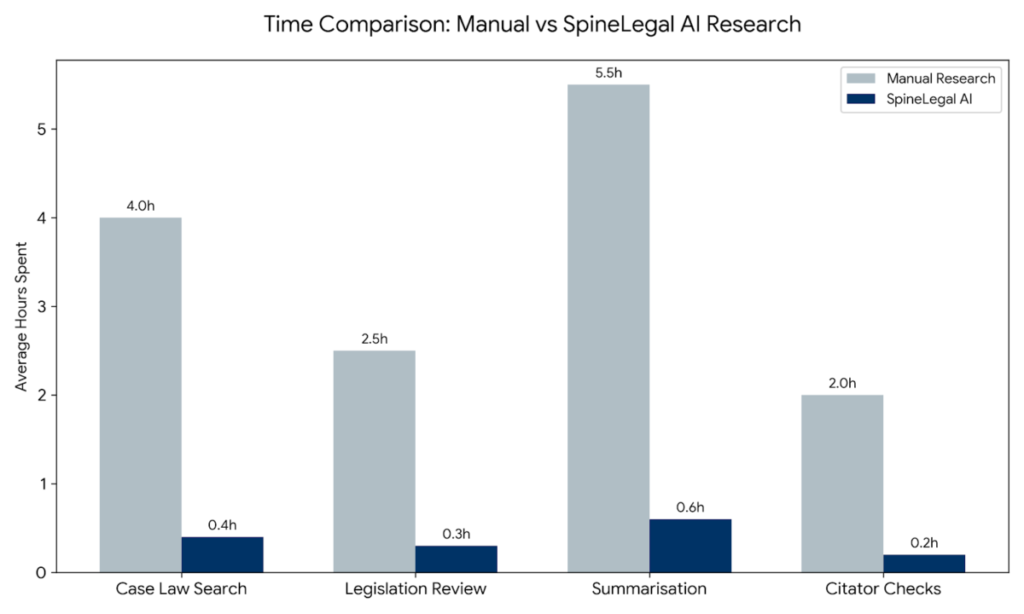
What might take a junior solicitor two to three hours of database searching can be completed in fifteen to twenty minutes using an AI platform. The tool surfaces the most relevant authorities immediately, rather than requiring the fee earner to read through pages of marginally relevant results.
Reading and noting up ten cases might take three hours. An AI tool can generate concise summaries of each judgment — ratio, key facts, and judicial reasoning — in under five minutes. The solicitor then reviews the summaries and reads the full text only of the most material authorities.
Manually verifying that a case has not been overruled or distinguished requires checking every subsequent case that cited it. AI citator tools automate this entirely, flagging any case that has been negatively treated and indicating the nature of that treatment.
Several AI platforms can now produce a structured first-draft research memo based on the query and results. This does not replace the solicitor’s judgment, but it provides a usable scaffold that might save two hours of drafting time on a complex matter.
Across a busy small firm handling 15 to 20 active matters, a 40% reduction in research time can free up the equivalent of one full working day per week, per fee earner.
Adoption without a clear implementation plan rarely delivers the expected benefits. The firms achieving the strongest time savings are those that have been deliberate about how they embed AI tools into existing workflows.
Not all legal work benefits equally from AI research tools. Litigation, regulatory compliance, employment law, and commercial contract disputes tend to yield the greatest gains. Conveyancing and probate matters with straightforward fact patterns may see more modest improvements.
Begin by auditing your current practice areas and identifying where fee earners are spending the most time on research. Those are the matters to target first.
AI research tools have a short but real learning curve. Fee earners need to understand how to phrase queries effectively, how to evaluate and critically review AI-generated summaries, and crucially, that the tool is an assistant rather than an authority.
The solicitor remains professionally responsible for the accuracy of any advice given. An AI-generated summary of a case does not substitute for reading the judgment when the point is material to the outcome.
The greatest operational gains come when AI research tools connect with the rest of your practice management software. SpineLegal, for instance, supports integrations that allow research outputs to be saved directly to a matter file, time-recorded, and cross-referenced with billing entries — eliminating the manual transfer of information between systems.
Before rolling out any new tool, record how long key research tasks currently take. After three months of use, compare the figures. Firms that measure see two benefits: they can quantify the return on investment, and they can identify where further efficiency gains are available.
Solicitors using AI tools are not absolved of their duty of competence under the SRA Code of Conduct. The obligation to provide accurate, current, and well-reasoned advice remains unchanged.
Several practical safeguards are worth building into your process:
The market for AI legal research tools has expanded rapidly. Evaluating platforms on the basis of a free trial or a sales demonstration alone is insufficient. Consider the following criteria:
Time saved on research directly affects the economics of a small firm in two ways. First, it reduces the cost of delivering a matter — meaning the firm’s margin on fixed-fee work improves. Second, it creates capacity that can be deployed on additional matters or on higher-value client-facing activity.
For firms billing on hourly rates, the picture is more nuanced. If AI tools complete in twenty minutes what previously took three hours, billing those twenty minutes at the same rate clearly reduces revenue from that task. The commercial response is to re-examine pricing strategy: moving to value-based or fixed-fee models that price the outcome rather than the time.
Firms that have made this transition report that clients respond positively. Legal buyers increasingly resist hourly billing for research-heavy work when they understand that AI tools exist. Getting ahead of that conversation — and demonstrating the value of your firm’s judgment, not just its time — is a strategic advantage.
The firms winning on AI are not simply the ones using it fastest. They are the ones that have reframed what they are selling: expert judgment, not billable hours.
The leading platforms have achieved high levels of accuracy on case law citation and legislative cross-referencing. However, no tool is infallible. Solicitors should treat AI-generated research summaries as a starting point, not a conclusion. Any proposition that is material to a client’s matter should be verified by reading the primary source.
Pricing varies considerably by platform and firm size. Most enterprise platforms offer per-user monthly licences ranging from approximately £100 to £400 per user. Some providers offer small-firm bundles. The return on investment calculation should factor in the billable time recaptured, which typically covers the licence cost within the first one to two months of active use.
There is currently no express SRA requirement to disclose AI use to clients, though this regulatory position may evolve. Best practice is to address AI tool use in your client care letter or engagement terms, particularly if client data is processed through the platform. Transparency supports trust and helps manage client expectations on delivery timescales.
No — and this is an important distinction. AI research tools augment the work of fee earners; they do not replace professional judgment, client-facing skills, or the ability to apply legal principles to complex, fact-sensitive situations. Many firms are redeploying paralegal capacity freed up by AI tools towards client contact, file management, and business development, rather than reducing headcount.
SpineLegal is practice management software built for law firms. Designed to help small, mid-size and large-size practices run more efficiently, SpineLegal integrates billing, time recording, client management, compliance workflows, and legal technology tools into a single platform. To learn how SpineLegal can help your firm reduce administration time and improve profitability, visit our website or book a demonstration with our team.

