

Legal office software has quietly become one of the busiest corners of legal technology. However, 2026 marks a turning point. Artificial intelligence is no longer a bolt-on feature. It’s now a core part of how firms manage matters, bill clients, and communicate. As a result, managing partners and IT leads are asking a new question. It’s not whether to adopt AI-enabled legal office software, but how to choose the right one. This article walks through where the category has come from and where AI is having the biggest impact. It also covers what to weigh up before your next upgrade. You can explore SpineLegal’s own approach to practice management as you read.
Where Legal Office Software Stood Before AI
Traditional legal office software focused on three core jobs: storing documents, tracking time, and managing deadlines. Firms relied on rules-based automation instead. Templates, reminders, and static workflows did most of the work. Consequently, most of the “intelligence” in a practice came from the fee earners themselves, not the software.
That model worked reasonably well for years. Nevertheless, it left firms doing a great deal of manual review, data entry, and cross-checking. Much of that work added little billable value. This is the gap AI has started to close.
AI-Powered Document Review and Drafting
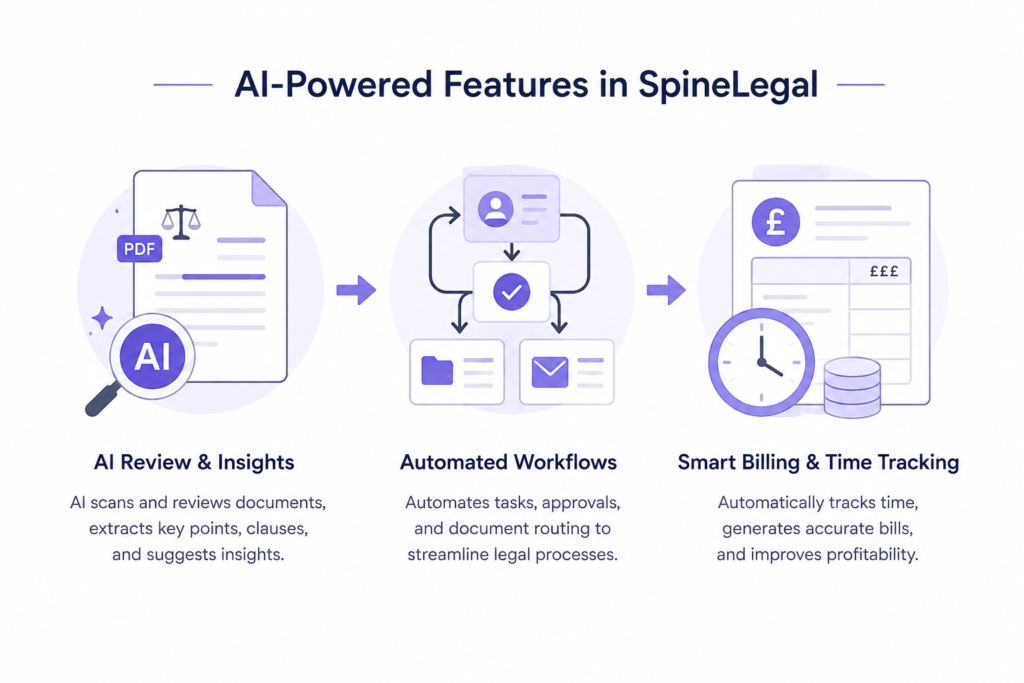
Perhaps the most visible shift is in document handling. AI-assisted review tools can now scan contracts and case files for key clauses. They flag inconsistencies or missing terms far faster than a paralegal could. In addition, drafting assistants can generate first-pass letters and disclosure summaries. They can also produce standard clauses based on matter data already held in the system.
Firms exploring this space in more depth may find it useful to read SpineLegal’s earlier piece on legal AI tools and their role in modern practices. It covers adoption considerations in more detail.
It’s worth noting that these tools assist rather than replace legal judgement. A solicitor still reviews and signs off on anything AI produces. The technology should be treated as a drafting accelerator, not a decision-maker.
Intelligent Case and Matter Management
Matter management is where AI-enabled legal office software starts to feel genuinely different. Instead of static task lists, some platforms now suggest next steps based on matter type. They can flag matters that are stalling or route documents to the right person automatically. Meanwhile, predictive prioritisation can help fee earners see which matters need attention first. It ranks them by deadline and case complexity, not simple date order.
For firms comparing options, SpineLegal’s case management software for lawyers page outlines how workflow automation fits within a broader practice management system. It’s a useful comparison point when evaluating AI-driven alternatives.
This kind of automation reduces the administrative load on fee earners. Therefore, more of their time goes toward client-facing and strategic work. Less of it goes toward chasing internal process steps.
AI in Legal Billing, Time Capture, and Accounting
Billing has historically been one of the more tedious parts of running a practice. AI is changing that steadily rather than dramatically. Time-capture tools can now infer billable activity from calendar entries, emails, or document edits. They then suggest entries for a fee earner to approve. As a result, firms often see fewer missed billable hours. They also spend less time on end-of-month reconciliation.
On the accounting side, anomaly detection can flag unusual transactions before they become compliance issues. It can also catch client account discrepancies early — a meaningful benefit given how strictly UK firms are regulated on client money. If your firm is reviewing this area specifically, SpineLegal’s pages on legal accounting software and legal time tracking software go into the underlying mechanics in more depth.
That said, automated suggestions still need a human final check. This matters particularly where client account rules are involved.
Client Intake, Communication, and AI Chat Assistants
Client-facing AI is also maturing. Chat-based intake assistants can now triage enquiries and collect initial case details. They route enquiries to the appropriate department before a fee earner ever picks up the phone. Similarly, some systems draft first responses to routine client questions. A team member then reviews and sends each one.
For smaller firms in particular, this can meaningfully reduce the administrative burden of intake without adding headcount. However, firms should be cautious about over-automating the first point of contact. Clients dealing with sensitive legal matters often expect a human response early in the process, not just an efficient one.
Risks, Compliance, and SRA/GDPR Considerations

No discussion of AI in legal office software is complete without addressing compliance. UK firms operate under strict obligations. AI tools do not change those obligations — they simply add a new layer of risk to manage. The Solicitors Regulation Authority has published guidance on the responsible use of AI in legal practice. Firms should treat that guidance as a starting point, not an afterthought.
Data protection is equally important. Any AI feature that processes client data, correspondence, or case files needs to align with the requirements set out by the Information Commissioner’s Office. This is particularly true around data minimisation and lawful processing. In addition, firms should ask software vendors direct questions. Where are AI models hosted? What data trains them? Is client information ever used outside the firm’s own environment?
Sector commentary from bodies such as the Law Society has consistently pointed to AI adoption accelerating across the profession. However, most firms are still working out where automation should stop and human review should begin. That balance will likely remain a live discussion throughout 2026.
What to Look for When Choosing AI-Enabled Legal Office Software in 2026
Given how quickly this space is moving, firms should look past the marketing. Ask a few practical questions before committing to a platform:
- Transparency — Can the vendor explain, in plain terms, what the AI feature actually does and where its data comes from?
- Control — Does your team retain final sign-off on AI-generated drafts, billing entries, and client communications?
- Compliance alignment — Does the vendor reference SRA and GDPR obligations directly, rather than treating them as generic small print?
- Integration — Does the AI feature work within your existing case management, accounting, and time-tracking workflows, or does it require a separate system?
- Track record — Has the vendor demonstrated stability and support for firms of a similar size and structure to yours?
Firms that ask these questions upfront tend to have a smoother rollout. Expectations get set clearly from day one, rather than discovered midway through implementation.
Conclusion
AI is reshaping legal office software in ways that go well beyond a single new feature. It’s changing how document review, matter management, billing, and client communication work day to day. Nevertheless, the fundamentals haven’t changed. Firms still need software that’s compliant, reliable, and genuinely useful to the people running the practice. As you evaluate your options for 2026, look closely at how each vendor balances AI capability with the oversight your firm needs. If you’d like to see how a UK-built platform approaches this balance, SpineLegal is a reasonable starting point for comparison.
FAQ
Is AI in legal office software safe to use under SRA rules? AI features can be used compliantly, but firms remain responsible for outcomes. The SRA expects solicitors to review and take ownership of AI-assisted work, rather than relying on it unchecked.
Will AI replace practice management staff in law firms? Not in the near term. Current AI tools are designed to reduce administrative workload. They aren’t designed to replace the judgement and client relationships that legal staff provide.
What’s the difference between legal office software and case management software? The terms overlap significantly. “Legal office software” often describes a firm’s full operational system. “Case management software” more specifically refers to matter-tracking functionality within that system.
How do I know if an AI feature in legal software is GDPR-compliant? Ask the vendor directly where data is processed and stored. Ask whether it’s used to train external models and how long it’s retained. A compliant vendor should answer these questions clearly and in writing.

